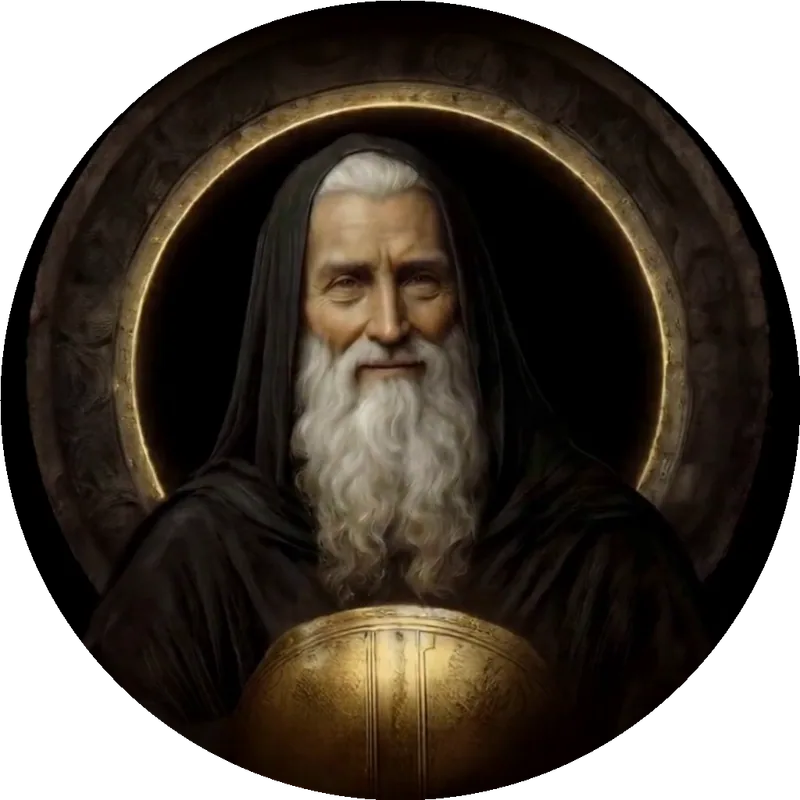
The Ark of the Covenant
The throne of Jehovah in Israel — its construction, contents, captivity, disappearance, and typological fulfillment in Christ.
“And there I will meet with thee, and I will commune with thee from above the mercy seat, from between the two cherubims which are upon the ark of the testimony.”
I. The Pattern Shown on the Mount
The Ark of the Covenant was not designed by men. Moses was shown the pattern of the tabernacle and its furniture on Sinai — a pattern after the heavenly original [Exodus 25:9, 40; Hebrews 8:5]. Every detail carried sacred weight because every detail was revealed.
“And they shall make an ark of shittim wood: two cubits and a half shall be the length thereof… And thou shalt overlay it with pure gold, within and without shalt thou overlay it, and shalt make upon it a crown of gold round about.”
Shittim (acacia) wood overlaid inside and out with pure gold — the fundamental typological structure of Christ’s own person: wood, an incorruptible creation of the earth, representing His humanity; gold, the purest metal, representing His divinity. The wood is inside the gold and the gold is over the wood. Two natures, one object. No seam.
II. The Mercy Seat — The Throne of God in Israel
On top of the Ark rested the kapporet — translated "mercy seat" in the KJV. The Hebrew root kaphar means to cover, to atone, to expiate. The mercy seat was not a mere lid; it was the place of atoning covering, where the blood of the sacrifices was sprinkled once a year on the Day of Atonement [Leviticus 16:14–16]. Above the mercy seat, between two cherubim whose wings overshadowed it, the Shekinah glory rested. This was the throne of Jehovah on earth.
“O God of Israel, which dwellest between the cherubims, thou art the God, even thou alone, of all the kingdoms of the earth.”
Wherever the Ark went, God was present in a particular way. The Ark crossed the Jordan ahead of Israel [Joshua 3]. The Ark brought down the walls of Jericho [Joshua 6]. The Ark struck Uzzah dead when he touched it without authority [2 Samuel 6:6–7]. The Ark moved the house of Obed-edom to blessing when it dwelt with him [2 Samuel 6:11–12]. The Ark was not a symbol of God’s presence — it was the meeting-place of God’s presence, the specific physical location from which He spoke to His people.
III. The Three Contents — A Threefold Christ
Hebrews preserves the tradition of what the Ark held:
“Which had the golden censer, and the ark of the covenant overlaid round about with gold, wherein was the golden pot that had manna, and Aaron’s rod that budded, and the tables of the covenant.”
Three objects. Each one a type of Christ in a different office:
- The golden pot of manna [Exodus 16:32–34] — Christ as the Bread of Life, the heavenly provision, the miraculous daily sustenance. "I am the bread of life… I am the living bread which came down from heaven" [John 6:35, 51]
- Aaron’s rod that budded [Numbers 17:1–11] — Christ the chosen High Priest, vindicated by resurrection life bursting out of dead wood. Aaron’s rod budded to silence the rebellion against the Aaronic priesthood; Christ’s rod of life bursts out of the grave to silence every challenger. "I am he that liveth, and was dead; and, behold, I am alive for evermore" [Revelation 1:18]
- The two tablets of stone [Exodus 25:16, 21] — Christ the embodied Law, the living Word of God. Jeremiah 31:33 prophesied the law written on the heart; Christ is the Law-in-Person who keeps it perfectly and fulfills it
The Ark is Christ in triple office: Prophet (the Word, the tablets), Priest (the rod of priesthood authority), and Bread (the daily life poured out for His people). And the blood on the mercy seat above is the Atonement itself, applied once and for all to the Covenant Person within.
IV. The Ark’s Captivity — 1 Samuel 4–6
In 1 Samuel 4–6 the Philistines capture the Ark in battle. Israel had taken it into combat as a talisman, thinking the object itself would save them. It did not — Eli’s corrupt sons Hophni and Phinehas died, thirty thousand footmen of Israel fell, and the Ark was carried off.
But the Ark immediately turned on its captors. In the temple of Dagon at Ashdod, Dagon was found fallen on his face before the Ark; the next morning his head and hands were broken off [1 Samuel 5:1–4]. Tumors broke out wherever the Ark was taken [1 Samuel 5:6–12]. After seven months the Philistines sent the Ark back to Israel on a new cart pulled by two milk cows.
The Ark in Philistine captivity is a type with many layers. The true presence of God cannot be possessed by the wicked; idols fall before Him; He afflicts the unrepentant who keep Him in captivity; and He returns to His people in His own time. Whenever the covenant is treated as a possession or a superstition, the Ark lesson applies: God is not handled. He handles.
V. Disappearance After 586 BC
The Ark is last certainly attested in 2 Chronicles 35:3, in the reign of Josiah, when it is returned to the temple. By the time Nebuchadnezzar destroys Solomon’s temple in 586 BC, the Ark disappears from the biblical record. The list of temple furnishings Nebuchadnezzar carries away does not include the Ark [2 Kings 25; 2 Chronicles 36]. When the temple is rebuilt under Zerubbabel and Ezra, there is no Ark; in the Second Temple, the Holy of Holies is empty. By rabbinic tradition, the second temple lacked five things that the first had: the Ark, the Urim and Thummim, the anointing oil, the sacred fire from heaven, and the Shekinah glory.
Jeremiah 3:16 anticipates the change:
“And it shall come to pass, when ye be multiplied and increased in the land, in those days, saith the Lord, they shall say no more, The ark of the covenant of the Lord: neither shall it come to mind: neither shall they remember it; neither shall they visit it; neither shall that be done any more.”
The Lord’s intent was not that the Ark be lost and mourned forever. The Ark would be eclipsed by the fulness of what it always pointed to — the Person of the Messiah. Once Christ arrives in the flesh, the golden chest that held the types is no longer needed; the types have become incarnate.
VI. D&C 84 and the Ark of the Patriarchal Order
D&C 84 frames the ancient priesthood line and the continuity of the covenant order. Within that framework, the Ark takes on a deeper reading: it is the tangible covenant anchor of the patriarchal order during the Mosaic dispensation. The line from Adam to Enoch to Noah to Abraham carried the covenant in person and in priesthood. Once Israel could not carry the fulness, the Ark was given as a physical repository of the tokens of the covenant, a permanent reminder of priesthood, law, and presence within a nation that had just rejected the higher law at Sinai.
“For whoso is faithful unto the obtaining these two priesthoods of which I have spoken, and the magnifying their calling, are sanctified by the Spirit unto the renewing of their bodies. They become the sons of Moses and of Aaron and the seed of Abraham, and the church and kingdom, and the elect of God.”
The ancient Ark guarded the covenant inheritance; the sons of Moses and Aaron become the living ark in the latter days, bearing within them the law, the priesthood, and the manna of Christ’s presence. The object pointed forward to the covenant people who would themselves become the dwelling of God.
VII. Typological Fulfillment — Christ and His People as the True Ark
Christ Himself is the true Ark:
- Acacia wood overlaid with gold — perfect humanity clothed in divinity [John 1:14]
- Mercy seat where blood is applied — "whom God hath set forth to be a propitiation [Greek hilastērion, the word the LXX uses for the mercy seat] through faith in his blood" [Romans 3:25]
- Manna inside — the Bread of Life [John 6:51]
- Rod that budded — the resurrected High Priest [Revelation 1:18; Hebrews 7:24–25]
- Tablets of the covenant — the Law incarnate [Matthew 5:17]
And the final image of the Ark is in Revelation 11:19, where John sees the heavenly temple opened and "the ark of his testament" revealed. The Ark is not destroyed or merely forgotten — it returns in the heavenly vision, its true location now disclosed, its witness vindicated. What Israel lost on earth, heaven never lost.
The Ark was always a preview. When the Veil of the temple tore at the crucifixion [Matthew 27:51], it tore precisely between the Holy Place and the Holy of Holies — between the people and the mercy seat. Access to the throne of God was no longer mediated through a gold-covered chest in a curtained room. The real Mercy Seat was Christ crucified, His blood applied once for all, the way into the Holiest opened forever [Hebrews 10:19–22]. The Ark is not gone. It has simply been magnified into its fulness.
| Exodus 25:10–22 | Construction of the Ark — wood and gold, cherubim, mercy seat, pattern shown on the mount |
|---|---|
| Leviticus 16:14–16 | Day of Atonement — blood sprinkled on the mercy seat for the sins of the people |
| Numbers 17:1–11 | Aaron’s rod that budded — vindication of priesthood, placed inside the Ark |
| 1 Samuel 4–6 | Philistine captivity; God cannot be possessed; Dagon falls; Ark returns |
| 2 Samuel 6:6–7 | Uzzah struck dead — the Ark is not a common object |
| Jeremiah 3:16 | The Ark shall be remembered no more — eclipsed by the fulness of the covenant |
| 2 Chronicles 35:3 | Last certain scriptural location of the Ark — reign of Josiah |
| Hebrews 9:1—14 | Ark, its contents, and the typology of Christ the High Priest entering with His blood |
| Romans 3:25 | Christ set forth as the hilastērion — the mercy seat itself, in Greek |
| Matthew 27:51 | Veil of the temple torn in twain — access to the Mercy Seat opened |
| D&C 84:33–34 | Sons of Moses and Aaron — the living covenant line carrying what the Ark once held |
| Revelation 11:19 | The heavenly Ark revealed in the temple of God — vindication of the type |